One kilowatt-hour.
Two jobs.
ThermalCore is a sealed compute module built in the exact shape of a standard screw-in heating element. It threads into the port your tank already has — the water cools the chips for free, and every watt of computation becomes the hot water you were buying anyway.
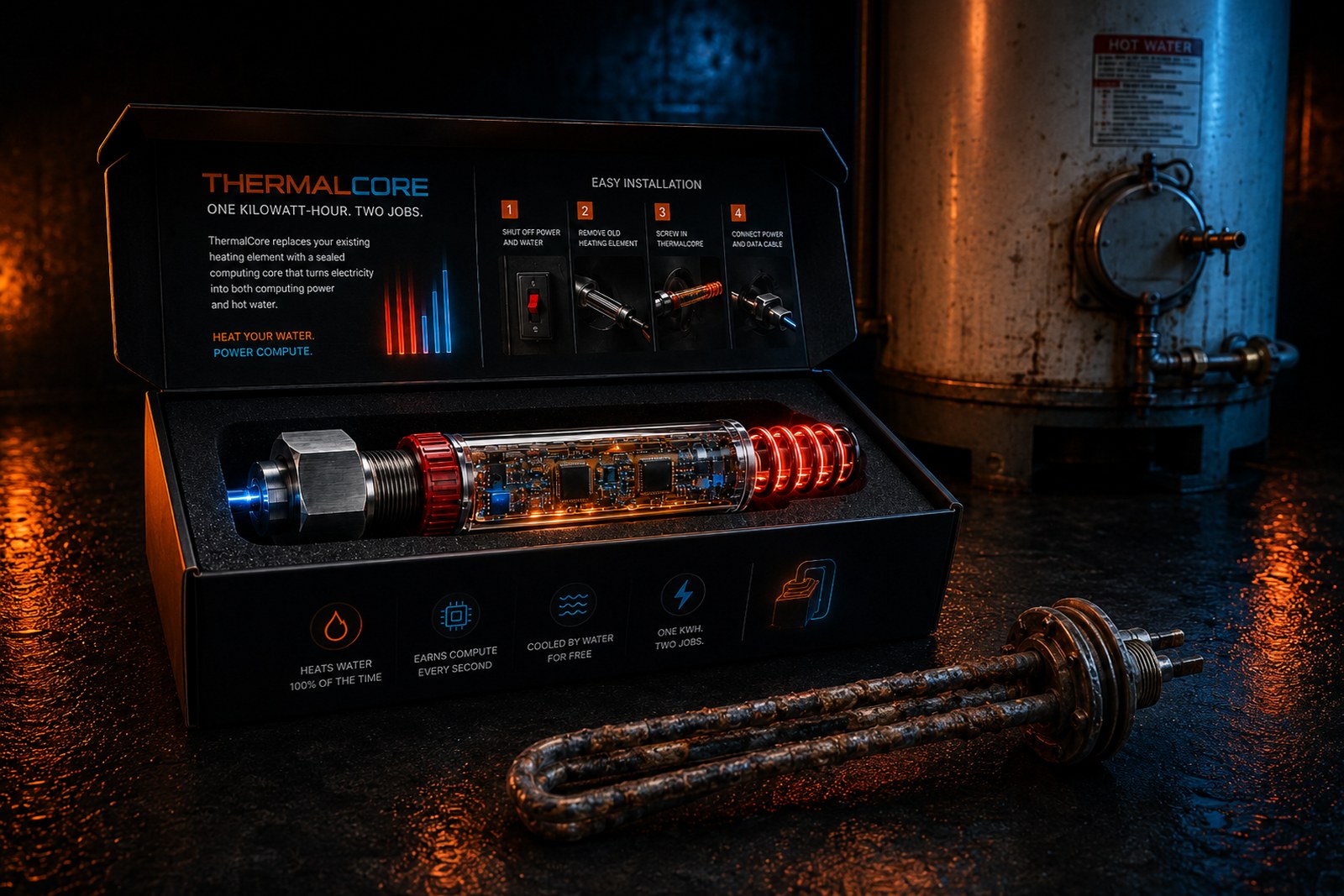
Same port, same heat — the ThermalCore module replaces the resistive element the tank already uses. Concept render.
The Problem
The economy pays for the same kilowatt-hour twice.
Computers turn electricity into heat — all of it, by physics. Data centers pay dearly to throw that heat away. Meanwhile the buildings around them burn more electricity to make heat on purpose. Two bills. One kilowatt-hour of actual work.
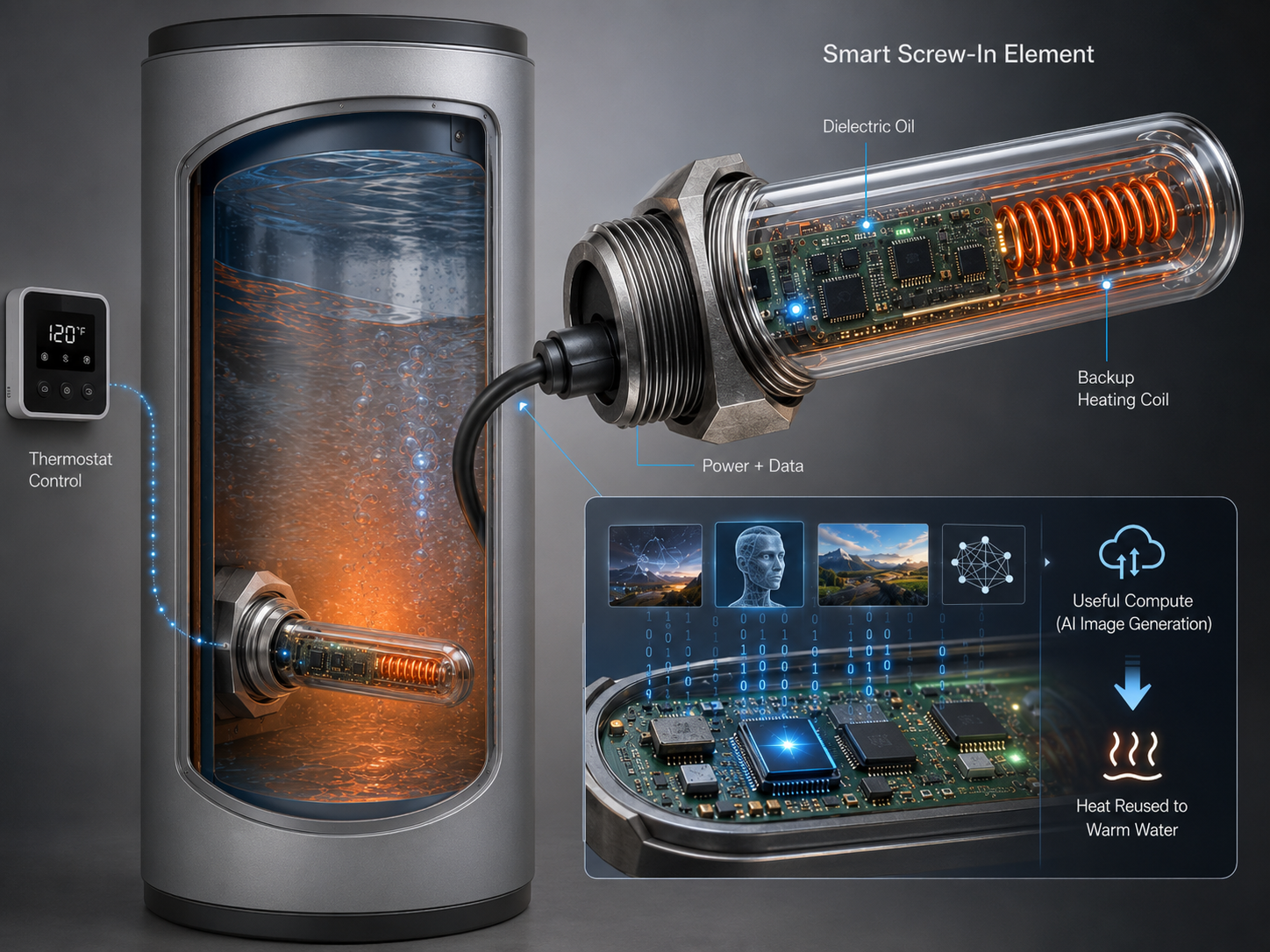
One kilowatt-hour, two jobs — the smart screw-in element inside a standard tank. Concept illustration.
Computing demand is exploding
U.S. data centers used 4.4% of national electricity in 2023 and are projected to reach 6.7–12% by 2028 (LBNL, 2024). Every one of those watts leaves as heat — mostly wasted.
Buildings burn power for hot water
Water heating is typically ~18% of a home's energy use — the second-largest load (EIA) — and a major around-the-clock load in many commercial buildings. It is heat made from scratch, right next to heat being discarded.
Working silicon becomes e-waste
Retired data-center and mining hardware — roughly 31 kilotonnes a year from Bitcoin mining alone (de Vries & Stoll, 2021) — still converts electricity to heat perfectly. It's an entire supply chain of heating elements, discarded.
How It Works
Same port. Same heat. New income.
Most electric water heaters — and virtually all U.S. residential tanks — share one standardized feature: the threaded element port. ThermalCore replaces the dumb resistor behind it with computation.
Unscrew. Screw in.
ThermalCore installs in the standard screw-in element port that electric water heaters, boilers, and industrial tanks already have. No new plumbing, no construction, no extra floor space.
Chips compute, sealed in oil.
Inside the stainless housing, processors run immersed in dielectric oil. The tank water surrounding the module is the heatsink — industrial-grade cooling the building gets for free.
Every watt becomes hot water.
Essentially every watt the chips consume ends up as heat in the water — the same conversion a resistive element performs. The computation revenue is the new part.
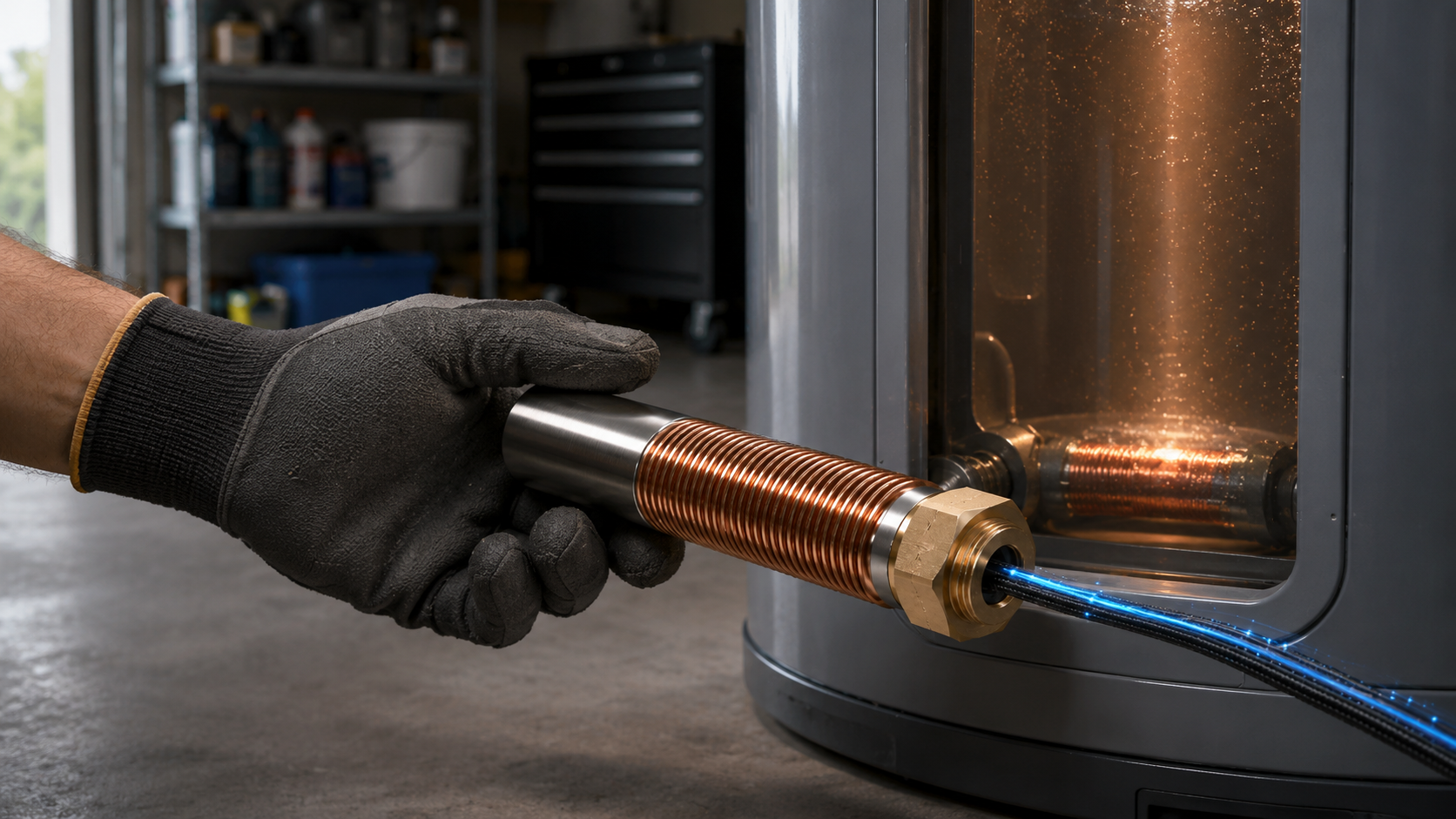
Concept illustration — installation is the same motion a plumber already knows: replacing a heating element.
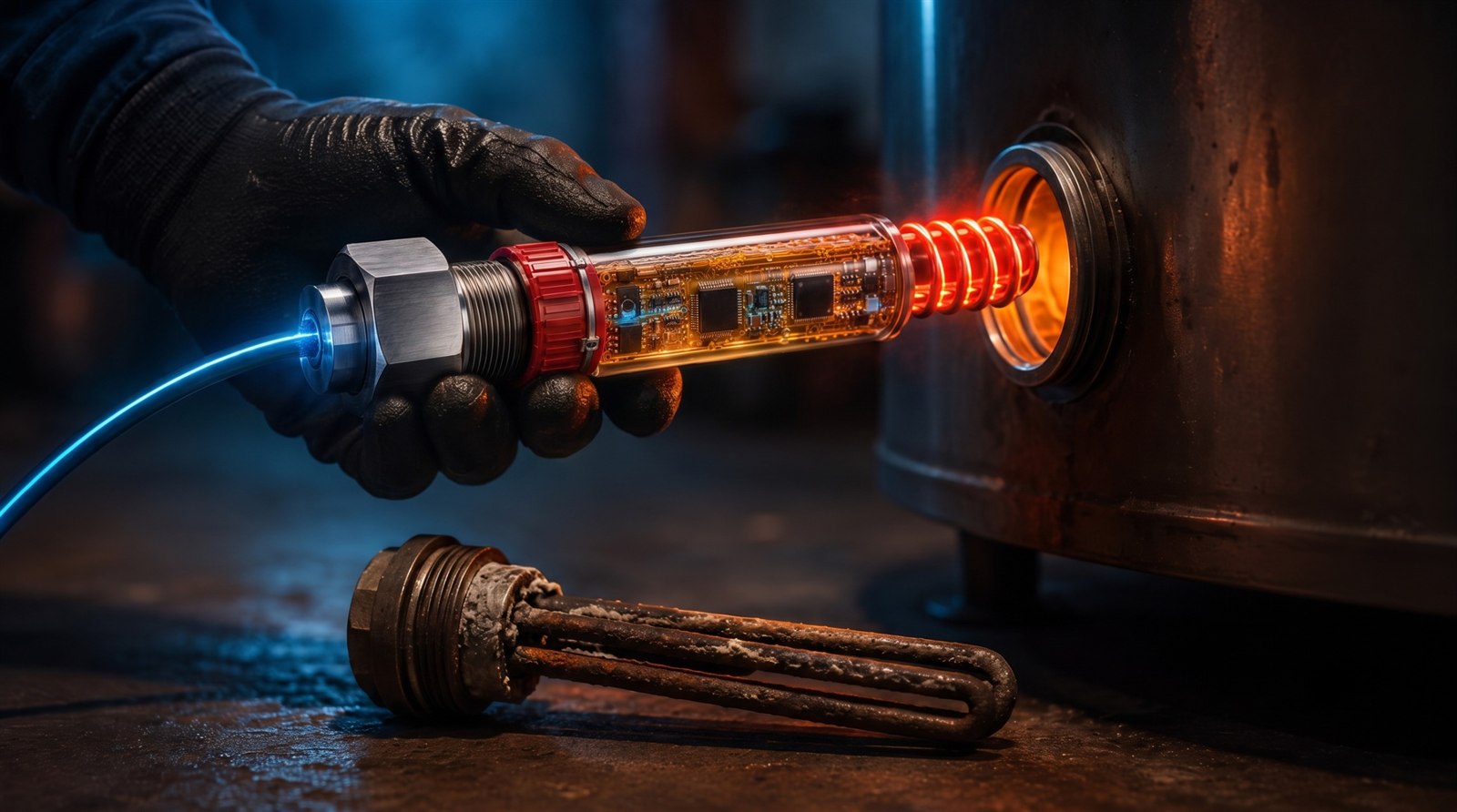
Concept illustration — the sealed compute core goes in where the old element came out. Power and data run through a single sealed feedthrough.
The Product Family
One invention. Six ways in.
The filed application covers the form factors that make an element-port computer practical in the real world — including a geometry problem no incumbent product addresses: almost nothing computes in a one-inch opening.
01Straight element
The drop-in: a rigid sealed module in the classic element shape, for tanks with clearance. Same install as the part it replaces.
02The flexible snake
A chain of narrow compute segments that threads through the one-inch port and coils inside the tank — more computing power through the same small opening.
03Buoyant deployment
A float-tipped snake that rises and self-arranges as the tank fills, spreading heat — and cooling — through the water column.
04Dry-well sleeve
A permanent sleeve that lets the compute cartridge be swapped in seconds — without draining the tank. Silicon ages faster than steel; serviceability is designed in.
05Hybrid fail-safe
Compute module plus a backup resistive coil in one housing, designed so that if the electronics ever stop, the coil takes over automatically and the building keeps its hot water.
06Forced circulation
A small built-in impeller propels the surrounding water across the module — heat transfer multiplies, more computing power fits through the same one-inch port, and the tank stays evenly mixed instead of stratifying.

The complete picture — snake coiled through the tank, buoyant tip at the surface, one screw-in fitting. Concept render.
Compute Workloads
The water gets hot either way. What the chips work on is up to you.
ThermalCore modules can run any computing job that tolerates being paced by the tank's demand for heat — the workload simply decides who pays for the electricity's first job.
 Bitcoin & crypto mining$0.01–0.04/kWh
 Rented cloud & batch compute$0.25–0.50/kWh
 AI inference & image generation$1–5/kWh
 3D & video rendering$0.25–0.50/kWh
 Scientific & research computing$1–5/kWh
 Data processing & analytics$1–5/kWh
What a kilowatt-hour of computing sells for, July 2026 — mining from live hashprice across common ASIC hardware; GPU-marketplace rates (loaded) for rented compute and rendering; published enterprise batch-compute list rates for AI, scientific, and data workloads. Gross revenue per kWh of electricity consumed; rates move constantly and utilization varies.
Where It Fits
If electricity heats a liquid, ThermalCore can be retrofitted into it.
Twelve of the places the threaded element port already lives — each one a retrofit, not a rebuild.


Market figures are approximate and conservatively rounded — U.S. Census Bureau, USDA, AHLA, PHTA, Brewers Association, IBISWorld, Grand View Research, Fortune Business Insights (2024–2025).
Beyond Heat
The element that also listens.
A resistive element has exactly two states: on and off. It can make heat, but it can never ask a question. ThermalCore can do both — because computation is a heat source software can dial to any level, precisely, while it is still earning. That turns the heating element into the tank's first real instrument. Patent pending.

Send a known pulse.
The controller nudges the compute load along a deliberate profile — a step, a ramp, a slow oscillation. It is a precise, repeatable amount of heat placed into the water on purpose. The chips keep working the whole time; nothing is wasted to take the measurement.

Watch how the water answers.
Sensors on the module — on the outer wall, at the tip, inside the dry-well sleeve, or spaced along the flexible conduit — record how fast the heat is carried away. Water, scale, sediment and air each answer with a different curve. The shape of that answer is the measurement.

Act on it, in the tank.
This is not a dashboard. The module responds physically: throttle back, shut down before damage, run the auxiliary coil through a de-scale cycle, or flag the unit for service before anyone notices a problem. The reading and the response happen in the same device.

Concept illustration — the module places a known amount of heat into the tank on purpose, then reads how the water carries it away.
Concept illustration — the module places a known amount of heat into the tank and reads how the water carries it away. Each fault has its own signature.
What a listening element can tell you

Dry-fire protection
If the tank drains or the module is uncovered, heat has nowhere to go and temperature runs away within seconds. ThermalCore sees the runaway slope and throttles or stops — protecting silicon, which fails far below the temperature a steel sheath tolerates.

Scale and sediment
Limescale is the single biggest cause of lost efficiency and premature failure in electric water heating. A growing crust slows heat transfer in a way that is unmistakable in the response curve — visible long before a technician could find it.

Water level and stratification
Sensors spaced along the flexible conduit read the tank as a column rather than a point. That shows how much usable hot water remains, where the thermocline sits, and whether the tank is short-cycling against a poorly placed thermostat.

Anode and corrosion health
Every tank carries a sacrificial anode that quietly dissolves. When it is gone, the tank itself starts corroding. A powered module in the water can watch the electrochemical environment and warn while the fix is still a $30 anode rod, not a flooded basement.

Seal integrity
The module is sealed and pressure-rated. It also knows what its own interior should look like, so a breach shows up as a change in internal conditions — and it can shut itself down and raise an alert rather than fail quietly.

Failing thermostats and elements
A tank that never reaches setpoint, cycles too often, or heats far slower than its own history suggests a fault elsewhere in the appliance. The module has the baseline to notice, because it has been measuring the same tank every day.
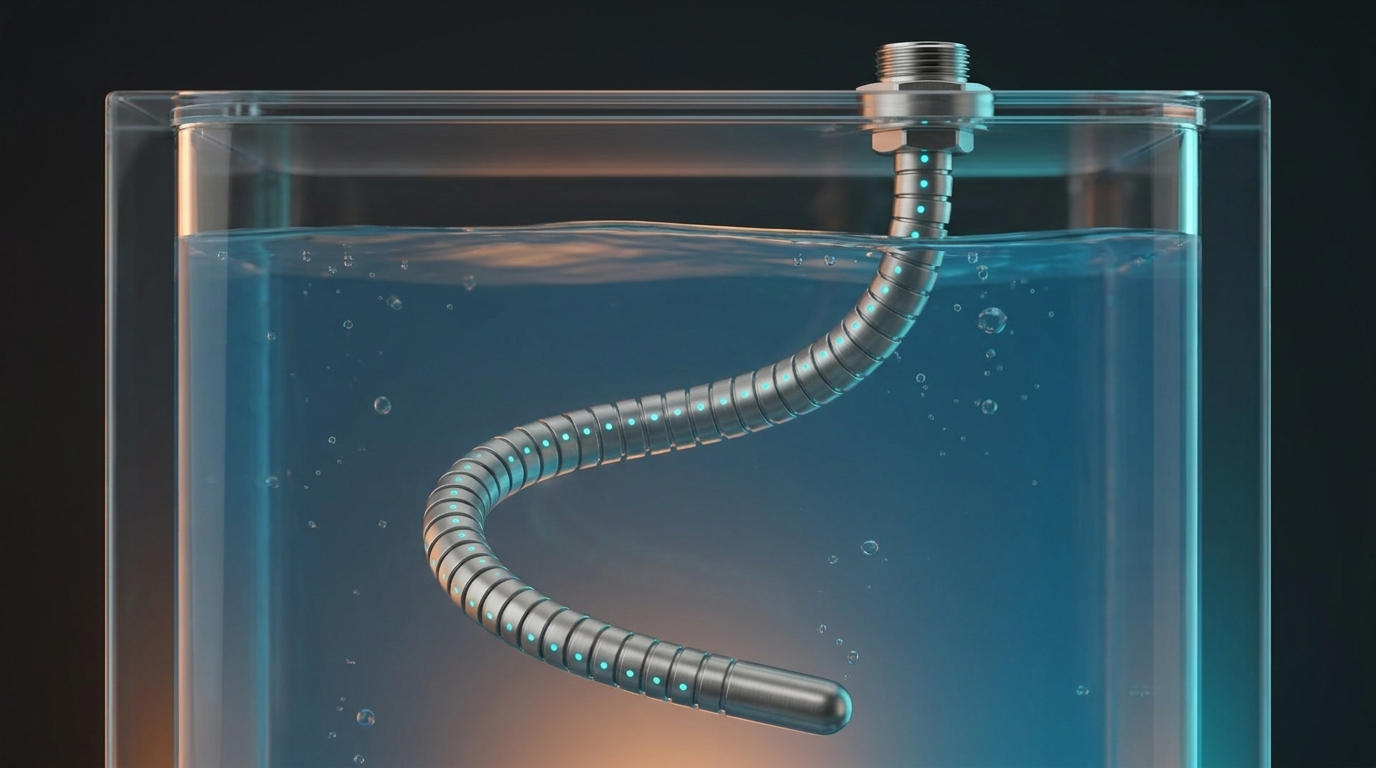
Concept illustration — on the flexible conduit, sensing points sit along the module's whole length, so the tank is read as a column rather than at a single spot.
Why this matters commercially

Recurring revenue, not a one-time sale
A heating element is sold once and forgotten. A component that predicts its own tank's maintenance feeds a service business every year it stays installed — which is exactly the model manufacturers and property operators already run on.

Leaks caught before the ceiling does
Water heater failure is one of the most common and most expensive property claims there is. Early warning from inside the tank turns a catastrophic replacement into a scheduled visit — which is a story insurers and building owners understand immediately.

Every unit reports, at scale
Across a portfolio, the same measurement becomes a maintenance map: which buildings scale fastest, which tanks are near end of life, where the hot water is actually being used. Useful whether or not a single kilowatt-hour of computing is ever sold.
The instrument costs nothing extra to add. The heat source was always going to be there — ThermalCore simply makes it controllable enough to ask a question, and smart enough to act on the answer.
Why Now
Three clocks are striking at once.

The law is creating the market
NYC Local Law 154 bans fossil-fuel combustion in new buildings — in force for buildings under seven stories since 2024, extending to all new buildings in July 2027 — effectively making new hot-water systems electric, with other jurisdictions following. Each new element port is a socket ThermalCore can fill.
Regulation
Compute demand needs somewhere to go
Data-center electricity is projected to grow to as much as nearly triple its national share by 2028 (LBNL, 2024). Distributed compute that pays for its own cooling — and sells its heat — is the pressure valve.
Demand
The hardware supply chain exists
The compute industry's upgrade cycle produces a constant stream of inexpensive, fully working processors. They're retired for being slow at math — but they're still perfect at making heat.
SupplyGo-To-Market
Beachhead first. Buildings next. License everything.
1 · Industrial process tanks
Aqueous parts washers and process baths already run on electric immersion elements at 60–82 °C, many of them near-continuously, year-round. Same port, full electric-rate heat credit, and owners who buy on payback. This is where ThermalCore lands first.
Beachhead2 · All-electric buildings
Commercial electric water heaters ship with as many as a dozen element ports. As electrification mandates take hold, ThermalCore turns every all-electric boiler room into a micro data center that pays part of the utility bill.
Scale3 · OEM & operator licensing
The endgame is the element itself as a licensed standard — adopted by water-heater manufacturers and heat-reuse operators who today build entire custom appliances to do what one screw-in part can do.
Endgame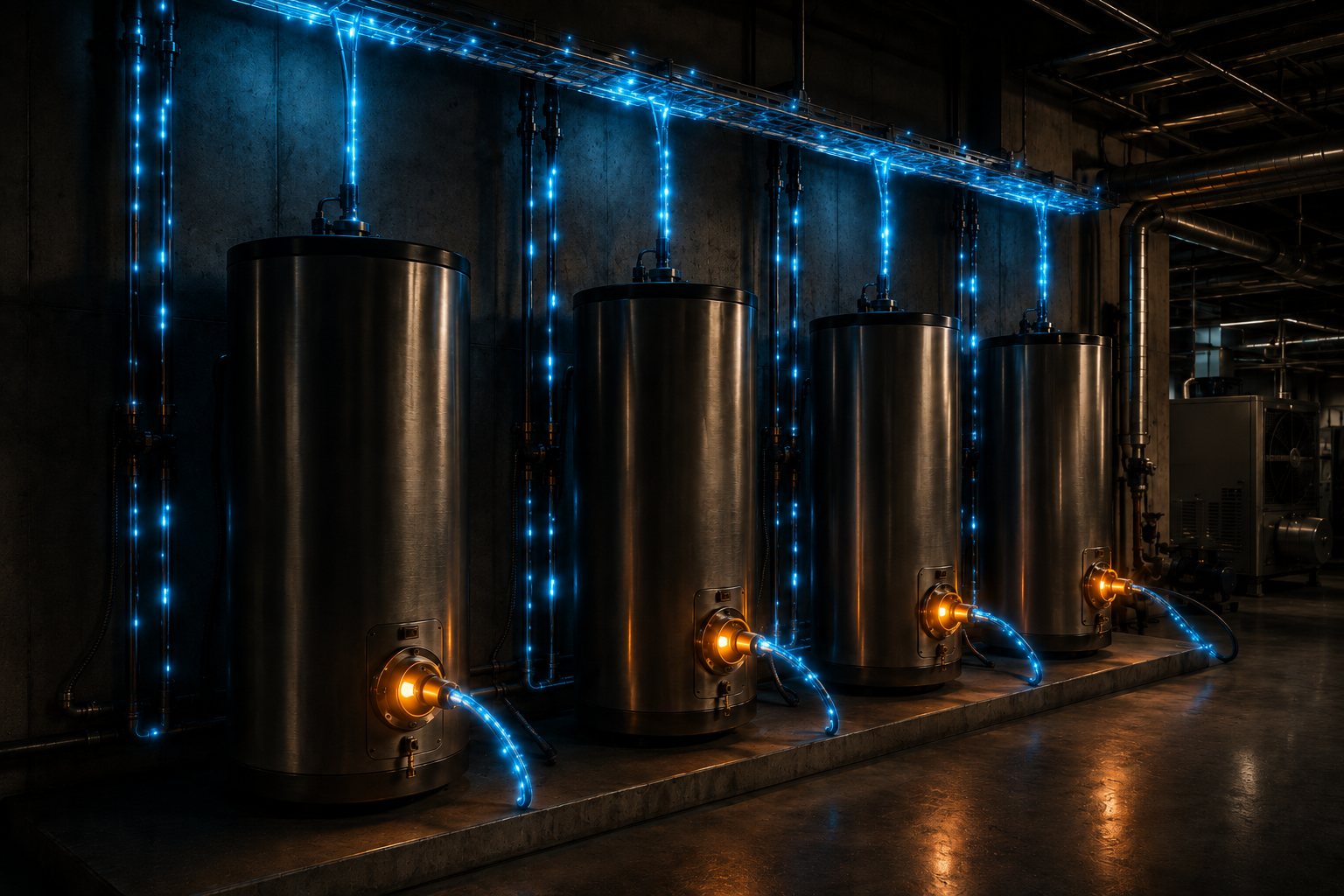
A ThermalCore fleet at building scale — every tank computing while it heats. Concept render.
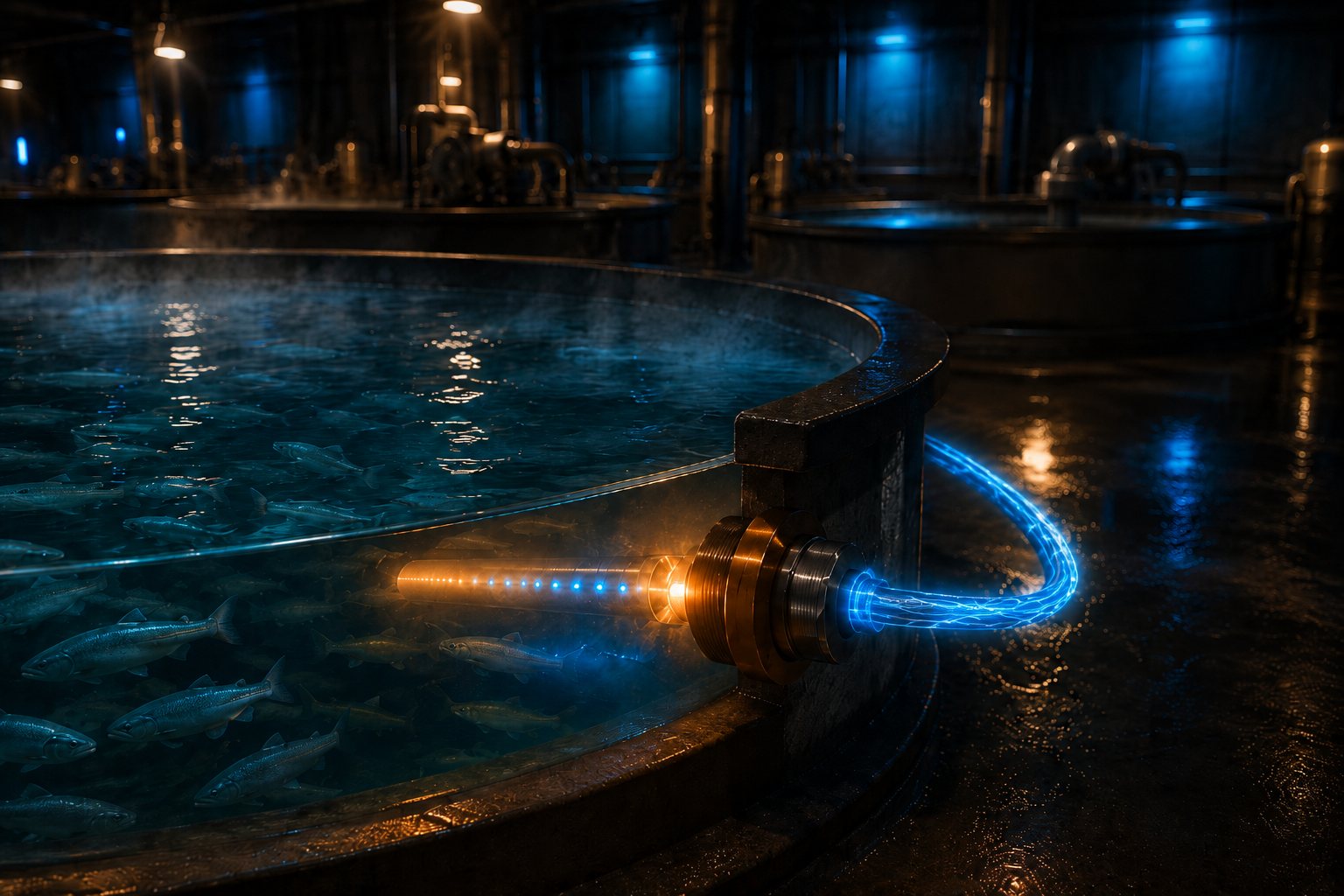
Aquaculture pilot vision — constant-temperature tanks, compute-heated water. Concept render.
The Technology & IP
Filed. Comprehensive. Retrofit-first.
Patent pending — “Immersion Computing Module for Liquid-Heating Appliances”
A full utility patent application with 20 claims (3 independent), drafted and filed by the inventor. The incumbents in heat-reuse computing build new appliances or external skids; the filed claims cover the retrofit path — computing inside the vessel the building already owns.

The sealed compute module in the standardized screw-in heating-element form factor.

The “snake” — chained segments that pass a one-inch port and coil inside the tank.

Float-assisted self-arrangement of the flexible module through the water column.

Cartridge swaps without draining the vessel — silicon re-cores on a steel timeline.

Integrated resistive element designed for continuity of hot water if the compute module fails.

Building-scale orchestration with demand-response participation across module fleets.
Status: awaiting first examination. A bench prototype — real silicon, sealed in oil, heating a real tank through the standard port — is in progress, with an instrumented build log to follow.
The Inventor
Built by someone who can write the IP, negotiate the license, and open the boiler-room door.


Inventor & Founder
LL.B. · LL.M. · PATENTS & CONTRACTS
Attorney, LL.B. and LL.M., specializing in patent and contract law. He drafts and files his own U.S. patent applications pro se as the inventor — ThermalCore is his fifth. IP strategy, licensing, and contracts are in-house by definition.
Real-estate operator. His day job is multifamily real-estate operations and investor relations across a large rental portfolio — which means direct access to the boiler rooms, building owners, and affordable-housing programs where ThermalCore's building-scale story starts.
Relentless inventor. A pipeline of filed applications, a bench prototype in progress, and one conviction: the cheapest heat in the world is the heat somebody already paid to make.
Be first in line.
ThermalCore is patent pending and we are talking to manufacturers now. Leave your details and we will send you updates as it moves — and everyone on this list gets first access when orders open, at a discount off the launch price.
You're on the list.
Thanks — we've got your details. We'll send you updates as ThermalCore moves, and you'll hear from us before orders open.
Questions in the meantime: hello@thermalcore.energy
Contact
Pilot sites, partners & licensing — let's talk.
Operating an electrically heated tank that runs around the clock? Electrifying a building's hot water? Building heat-reuse infrastructure? ThermalCore is looking for early pilot partners.
The Business Plan
The whole plan, in the open.
For operators, partners, and the curious: the complete ThermalCore business plan — the same story we tell in meetings. Keep scrolling.
Executive summary
Everything above this line is the product story; this is the company plan. The one-sentence version: every incumbent in heat-reuse computing builds a new appliance — our patent-pending claims cover the retrofit, computing inside the vessel the building already owns, and the plan below turns that position into a certified product, a pilot fleet, and an OEM licensing path.
The funding plan — $1.25M pre-seed
An 18–24-month execution window: professional product development with a mid-tier U.S. engineering firm through a certified, pilot-proven product; ETL/UL safety listing; a 25-unit pilot fleet across three beachhead verticals; IP expansion; and operating runway to a $3–6M seed on proof. Benchmarks: U.S. climate-hardware pre-seeds run $500K–$1.5M (Carta, 2025); the most direct U.S. comparable, Watter, closed a $5M seed in March 2025; Deep Green's heat-reuse model drew a £200M scale-up from Octopus Energy once proven. Informational only — see the notice in the footer.
Market: honest funnel
The twelve verified host industries above show the sockets number in the millions and their operators already pay for heat. The funnel converts that into a serviceable market: high-duty electric tanks are where compute-heat economics clear today, and the three-year obtainable slice assumes only the beachhead verticals in one region. Approximate, conservatively rounded, 2024–2025 sources; SAM/SOM are management estimates.
Competitive landscape
| Player | Architecture | Traction signal | What they can't do |
|---|---|---|---|
| Deep Green (UK) | Immersion data centers + heat exchanger to pools/leisure | £200M from Octopus Energy (2024) | Needs plant-room build-out; gives heat away free; no retrofit product |
| Qarnot (FR) | Compute radiators & boilers (new appliances) | €35M+ raised; enterprise batch clients | Sells new capex; doesn't touch existing tanks |
| Heata (UK) | Server bolted to outside of domestic cylinder | £1M seed; British Gas pilot heritage | Conduction from outside = limited power; UK domestic focus |
| MintGreen (CA) | Boiler-scale "digital boilers" for district heat | City of North Vancouver contract | Utility-scale sales cycle; not appliance-level |
| 21energy / Hestiia (EU) | Bitcoin space heaters (new appliances) | €1.1M / $1.4M early rounds | Air heaters; no liquid integration, no port claim |
| Watter (US) | Compute-heat water heating systems | $5M seed (Mar 2025) | Validates the U.S. market; system-level, not element retrofit |
The structural gap ThermalCore occupies
Every player above asks the customer to buy a new appliance or build a plant room. ThermalCore asks them to replace a $30 part during routine maintenance. The patent-pending claims sit on that retrofit interface — if incumbents ever want this lane, or OEMs want to ship "smart element" SKUs, ThermalCore is the natural partner or licensor. Their funding levels simultaneously validate the space and price its upside.
Business model & unit economics
Duty in a parts washer: ~20 h/day → ~21,900 kWh/yr through one 3 kW module.
Heat delivered: the same kWh the owner already bought — displaces ~$2,950/yr of electric heating at a $0.135/kWh blended commercial rate.
Compute revenue at July-2026 mining rates: $440–880/yr gross, shared owner/ThermalCore.
Customer economics: heat they were buying anyway + compute share + demand-response credits → effective payback 14–20 months on pilot pricing (mgmt. estimate).
COGS at volume: ~$650/module (pilot units 2–3× that, per NPI benchmarks) → target blended gross margin ≈ 60% with SaaS.
Customer payback gauge, months — pilot pricing, beachhead duty cycle (illustrative)
Sizing discipline (the lesson incumbents ignore)
Revenue is capped by kWh of heat the host absorbs, not kW of compute installed. ThermalCore sizes to the host's summer minimum and targets near-continuous draw — that is why parts washers, aquaculture, and cold-storage loops outrank residential tanks, and why "size to the tank, not the rack" is a design rule in the fleet controller.
Product development plan — professional engineering, priced from published benchmarks
Development is outsourced to a mid-tier U.S. product-development firm (blended $150–250/hr) under founder IP oversight — not a homemade build. Figures from published 2024–2026 firm benchmarks; program planned at range midpoints with 25% contingency.
| Phase | Scope | Published range | Plan | Duration |
|---|---|---|---|---|
| P0 · Feasibility & architecture | System architecture, thermal/electrical feasibility, safety-standard gap analysis | $25K–$75K | $60K | 6–8 wks |
| P1 · Engineering prototype (alpha/EVT) | Oil-tight sealed housing, power electronics, firmware + connectivity, 3–5 prototype spins | $150K–$400K | $280K | 5–8 mo |
| P2 · DVT + safety certification | Design-for-manufacture; ETL/UL-path listing of a 240V heating appliance; FCC Part 15 | $100K–$300K + $20K–$60K certs | $205K | 4–6 mo |
| P3 · Pilot batch (25 units) | CNC stainless housings, PCBA, potting, functional test fixtures, attrition overage | $18K–$42K | $35K | 8–16 wks |
| P4 · Field pilots (3 sites) | Instrumented deployments: parts washer, aquaculture, multifamily hot water | — | $40K | 4–6 mo |
| Program total (18–24 months) | $620K | ~18 mo | ||
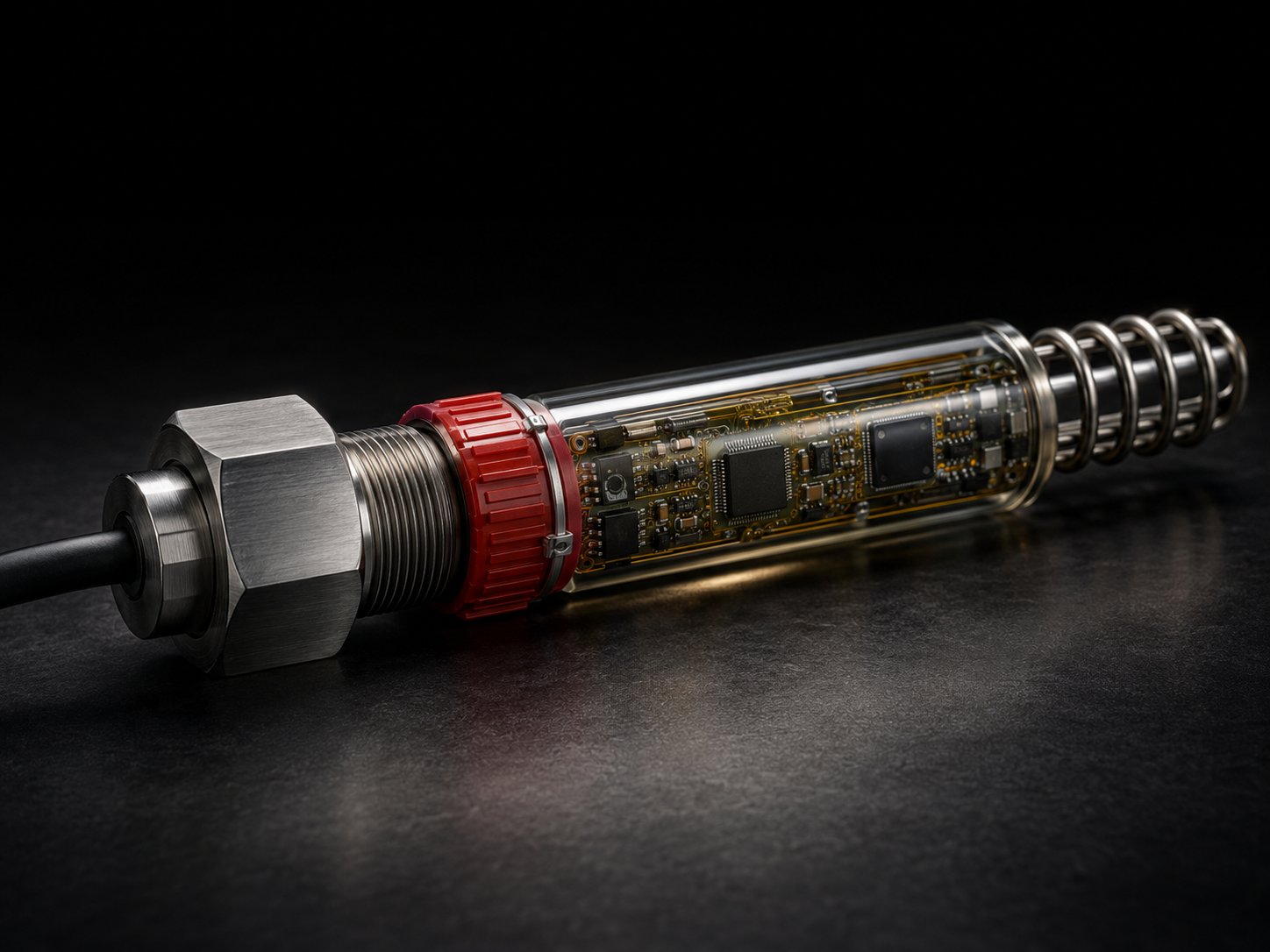
Engineering concept — threaded fitting, sealed compute core, backup coil. Concept render.
Financial plan — the $1.25M, dollar by dollar
Management scenario, not a forecast: assumes certification on plan, pilot conversion in the beachhead, a $3–6M seed for the 2027-28 scale-up, and mining economics post-2028-halving replaced progressively by batch-compute demand.
Grant stacking (non-dilutive, already mapped): NSF SBIR Phase I ($305K-class) and DOE SBIR ($200–250K) applications post-incorporation; NYSERDA electrification solicitations anchored on committed affordable-housing pilot sites; utility demand-response revenue from the first fleet. Every grant dollar extends runway without dilution; none is assumed in the budget above.
Risks & mitigations
| Risk | Reality check | Mitigation built into the plan |
|---|---|---|
| Mining economics decay (Apr 2028 halving) | Compute subsidy halves on a known date | Heat is the product, compute is the rebate; trailing-edge ASIC paybacks inside the halving window; fleet migrates to batch compute as it scales |
| Certification surprises (240V wet heater) | First-pass failures add 3–6 wks each | UL-experienced firm from day one; safety-standard gap analysis before design freeze; ETL path is 20–40% cheaper/faster than UL for identical standards |
| Patent prosecution | First examination typically 18–24 mo out | Founder prosecutes in-house; continuation family extends coverage; the business sells on "patent pending" + trade-secret fleet software meanwhile |
| Host absorption limits | Tanks absorb only what they use | Duty-cycle-first site selection; controller sizes to summer minimum; no residential SKU until the service model matures |
| Incumbent response | Well-funded players could pivot to retrofit | That pivot crosses the patent-pending claims — converting competitors into licensees; speed to pilot data and OEM conversations first |
| Single-founder execution | Hardware is a team sport | The round explicitly buys a professional engineering firm plus a founding engineer; the founder focuses on IP, sites, and capital |
Sources: U.S. Census Bureau, USDA NASS, AHLA, PHTA, Brewers Association, IBISWorld, Grand View Research, Fortune Business Insights (2024–2025); LBNL 2024 U.S. Data Center Energy Usage Report; EIA; de Vries & Stoll (2021). Development costs from published firm benchmarks (Analogy Design, ByteSnap, Jaycon, MistyWest, Design1st, Bolt VC, Dragon Innovation, Glencoyne, Amtech, FixturFab, Xometry, Sheridan Technologies, Intertek, 2024–2026). Funding benchmarks: Carta, PitchBook-NVCA, Sightline Climate/CTVC; company rounds per public announcements. Workload rates are July 2026 snapshots and move constantly. Financial projections are management estimates for planning, not forecasts. Nothing on this page is an offer to sell or a solicitation of an offer to buy securities.